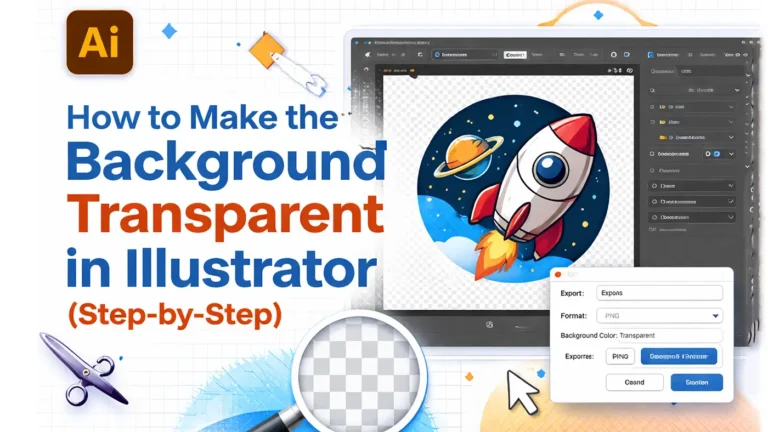
A transparent background is useful when you want to place your logo, icon, or design on any color without a white box behind it. In this guide, you will learn how to check transparency, remove background if it exists, and export a transparent PNG in Adobe Illustrator. The steps are simple and easy to follow.

1) Open or Place Your File
First, open your artwork in Illustrator. Go to File > Open and choose your AI file. If you are working with an image (like JPG/PNG), bring it in using File > Place, then click to place it on the artboard. Try to keep your design inside the artboard area. This helps you export the final file cleanly.
2) Turn on the Transparency Grid (To Check)
Now you need to confirm if your background is transparent or not. Go to View > Show Transparency Grid. You will see a checkerboard pattern behind your artwork. Remember, this grid only helps you see transparency. It does not remove the background by itself.
3) Delete the Real White Background (If There Is One)
Sometimes your design has a real white background shape behind it. Click the white area using the Selection Tool (V). If a shape gets selected, that means it is a real background object.
Press Delete to remove it. Then check again with the transparency grid to make sure the checkerboard shows behind your design.
4) If It’s a JPG/Photo: Use Image Trace (Optional)
If your artwork is a JPG or photo, the background might be part of the image. In that case, you can try Image Trace (best for simple logos and icons).
Select the image, then go to Window > Image Trace. Choose a preset like Black and White Logo for logos. Then click Trace to create a traced version.
After tracing, go to Object > Expand. This turns the trace into editable shapes.
5) Clean Extra White Parts After Tracing
After you expand the traced image, you may need to separate the parts. Go to Object > Ungroup (repeat if needed). Now, click the unwanted white background parts and press Delete.
Zoom in to check the edges. If the edges look rough, you can adjust Image Trace settings and trace again.
6) Fast Method: Clipping Mask (Hides Background)
If you want a quick result, you can use a Clipping Mask. This method hides the background instead of deleting it.
Draw a shape around the part you want to keep. Place that shape on top of the image. Select both the shape and the image, then go to Object > Clipping Mask > Make. This is great for fast cutouts, but remember: it hides the background, it does not remove it.
7) Export as a Transparent PNG (Most Important Step)
Now export your design the correct way. Go to File > Export > Export As. Choose PNG as the format. If you want to export only the artboard area, check Use Artboards.
Click Export. In the PNG settings, choose Background Color: Transparent. Then click OK. Now your PNG will save with a transparent background.
8) Quick Tips (Avoid Common Problems)
- Do not export as JPEG, because JPEG does not support transparency.
- If your PNG looks white in a viewer, test it by placing it on a colored background or opening it in a browser.
- For logos and icons, SVG is also a great format because it stays sharp at any size.

Need a Perfect Transparent Background? We Can Do It for You
If you don’t want to spend time tracing, cleaning edges, or fixing messy exports, our team can help. Image Expert offers professional background removal and transparent PNG creation for logos, product images, and graphics. You’ll get clean edges, the correct size, and ready-to-use files for web, print, and social media. Visit Image Expert India to request the service and get your transparent image done fast.
Conclusion
Making a transparent background in Illustrator is easy when you follow the right steps. First, check transparency using the Transparency Grid. Next, delete any real background shape if needed. Finally, export your file as a PNG with Transparent background settings. With this method, you will get a clean, professional, and transparent image that you can use anywhere—on websites, in videos, on social media, or in print designs.
FAQ (Frequently Asked Questions)
1) How Do I Make The Background Transparent In Illustrator?
Turn on the Transparency Grid from View > Show Transparency Grid to check if your background is already transparent. If you see a white shape behind your design, select it and press Delete. Then export your file as PNG and choose Background Color: Transparent in the PNG options. This will save your image with a transparent background.
2) How Do I Make The Background Transparent In Adobe Illustrator?
The steps are the same in Adobe Illustrator. First, check transparency using View > Show Transparency Grid. Remove any real white background shape if it exists. Finally, export as PNG and select Transparent in the export settings.
3) How Do I Remove The Background In Illustrator?
If the background is a shape (like a white rectangle), select it and press Delete. If the background is inside a photo (JPG), you may need Image Trace or a Clipping Mask. After removing or hiding the background, export as PNG with transparency enabled. Always re-check with the Transparency Grid before exporting.
4) How Do I Remove A White Background In Illustrator?
Click the white area using the Selection Tool (V). If it selects a shape, it’s a real object—press Delete. If the white background is part of a JPG image, use Image Trace (best for logos) or use a Clipping Mask to hide it. Then export as a transparent PNG.
5) How Do I Make An Illustrator Background Transparent When Exporting?
Go to File > Export > Export As and choose PNG. Check Use Artboards if you want only the artboard area. In PNG Options, choose Background Color: Transparent. Click OK, and your export will keep transparency.
6) How Do I Remove Background From An Image In Illustrator?
If your image is a photo (JPG), the background is usually part of the image itself. For simple logos, use Image Trace, then Expand, then delete unwanted parts. For a quick result, use a Clipping Mask to hide the background area. After that, export as PNG with transparency.